Mimir is a free app that runs AI assistants for you. Message them in Telegram, Slack, Discord or the app itself: they remember what you tell them, remind you, check things on a schedule, and work with your email, calendar and the web, asking you before anything that matters. They run on the Claude, ChatGPT or Grok plan you already pay for.
How it worksmacOS, Windows, Linux · free and open source
suggests
What Mimir is
An app you install that runs AI assistants for you; we call them bots. You talk to them in plain words, the way you’d message a person, and they act with the tools you give them.
Install the appOn your Mac, Windows or Linux computer, or on a server of your own. There’s no Mimir account to make.
Sign in with the AI you haveClaude, ChatGPT or Grok, on the plan you already pay for, so there’s nothing extra to pay. Or an API key, or a model on your own computer.
Message your botIn the app, or from your phone: connect it to Telegram, Slack or Discord in a minute.
Things you can ask
Remind me in two hours to call mum.A message at 16:30, then the reminder is gone.
Every weekday at 7:30, brief me on tech news in three bullets.A routine: there each morning, in Telegram.
Any emails from Sam about the invoice? Draft a yes.It searches your inbox and leaves a reply in your Drafts.
When am I free on Thursday?It reads your calendar.
Watch example.com/pricing and tell me if it changes.A quiet check that only speaks up when it does.
What did we decide in standup?It reads the call you transcribed on your computer.
No, shorter. Three bullets.It offers to remember that; accept, and all your bots follow it.
Mimir isn’t an AI model of its own: it uses yours. And it isn’t a cloud service: what your bots know about you is one file on your computer.
A memory you can read, correct and undo
Everything your bots know about you is a list like this one, and each line says where it came from.
Each suggestion brings its reason. Push back on a reply twice and the tidy-up offers a rule for it. Correct one once, and the next request like it comes with what you said.
2 suggested changes From recent conversations.
Forget
Talk abstractSubmit the meetup talk abstract by 30 September.You said it went in on the 28th.
Remember
Weekly review When writing the weekly review, keep it under 150 words.You asked for a shorter one twice.
Nothing waiting. Your bots will suggest more after the next quiet half hour.
Every memory says who wrote it: you, a bot in a given run, a tidy-up, an import. Mimir records that itself; it never takes the model’s word for it.
News format
When giving tech news, always use three bullet points with links.
tidy-up, approved by you1 h agorecalled 3×#7
A correction keeps what it replaced. Erase removes both, for good.
Coffee
Switched to black coffee, no milk.
you said5 h agocorrects #1#3
earlier version
Flat white with oat milk, one in the morning. you said · 12 Sep
Saved after reading a web page? It’s marked, and your bots treat it as unconfirmed until you say it looks right. A planted instruction never reads like something you said.
Partner
Sam. Anniversary is 14 March.
Ada, after reading calendar.example.comyesterdayafter reading outside content#6
A pinned memory is always in front of your bots, however much else there is. Incognito chats can’t see any of it, and keep nothing.
Dentist pinned
Dr. Naledi Lee in Stellenbosch; usually books Tuesday mornings.
you said, in Telegram3 h agorecalled 4×#4
Talk to it where you already talk
Telegram, Slack, Discord or the app on your desktop. In group channels it only answers when you @-mention it, and /stop cuts a reply off.
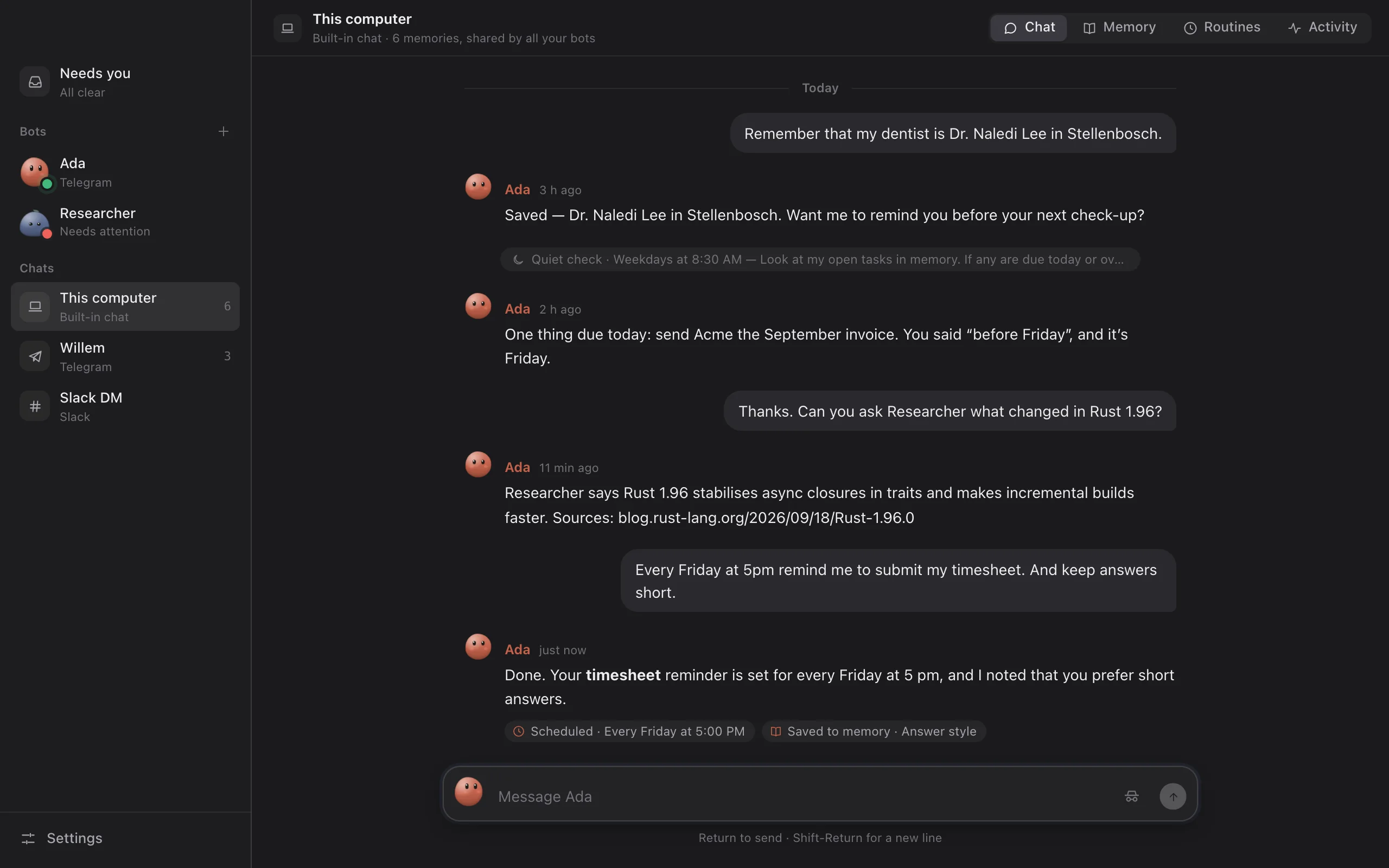
Ada bot# home Thread# generalThis computer 6 memories, shared by all your bots
YYou
@Ada Every Friday at 5 pm remind me to submit my timesheet. And keep answers short.
@You Every Friday at 5 pm remind me…Ada app
Done. Your timesheet reminder is set for every Friday at 5 pm, and I’ve noted that you prefer short answers.
Scheduled · Every Friday at 5:00 PMSaved to memory · Answer style
The same bot and the same memory, in four places.
Routines, in plain words
Say “every weekday at 7:30, brief me on tech news” and it’s scheduled. “Remind me in two hours to call mum” runs once. Quiet checks only message you when something needs you.
Friday
00
03
06
09
12
15
18
21
24
Ada
Page watcher
Weekly reviewer
AdaMorning brief: three headlines, one line each, with links.
Page watcherstatus.example.com has returned 502 since 11:52. The quiet check spoke up.
Weekly reviewerYour week: the Acme invoice went out, Lisbon is booked, the contract review is still open.
AdaTimesheet. It’s Friday.
AdaDaily digest: 9 quiet checks ran; one needed you.
Each routine is sent right away, saved for your daily digest, or just logged. Every run is kept in Activity.
Your inbox, your calendar and the web
Connect what you want them to work with. Each takes a few minutes, and each is optional.
Email
“Anything from Sam about the invoice?” Bots search and read your mail, write drafts, and send one when you approve it. Nothing is marked read, moved or deleted.
Calendar
“When am I free on Thursday?” They read it from its private link, and add events to iCloud or Fastmail when you approve, or give you a link to save.
Web search
For every AI account, through a free Brave Search key or your own SearXNG. Then they read the pages that matter.
Files
Each chat keeps a small folder of notes, lists and drafts too long for a memory. Rewriting one keeps the last version.
Gmail, iCloud, Fastmail and any mail with an app password; Google, iCloud and Outlook calendars. How to set each one up.
Skills, from a library or from what worked
A skill is the steps for one kind of task. Bots read them only when a task fits, or when you type its name.
Morning briefing
Today’s calendar, open tasks and what you follow, in ten lines. Schedule it in one click.
Inbox triage
What needs you, what’s FYI, what’s noise, with short replies left as drafts.
Price watch
Tells you when something drops below your price or is back in stock.
Weekly review
Done, slipped, and next week’s priorities, from your memory and chats.
Fourteen in Mimir’s library, written for its tools: plain text, nothing downloaded, and none added until you press Add. A task that went well can become a skill too; say “save that as a skill” and press Save. All of them.
Several bots, one memory
Each has its own job, AI account and tools, and any of them can hand a task to another. Ask one for a new bot for a job, and you approve it after reading its whole role.
AdaYou’re my personal assistant. Keep answers short.Telegram, desktopClaude · your plan
ResearcherRead the sources before answering, and always link what you used.SlackChatGPT · your plan
Morning brieferFive bullets at most, most important first.Telegramqwen3 · on this computer
Page watcherCompare with last time, and only report real changes.DiscordOpenRouter · your key
Weekly reviewerBe honest and specific, and keep it short.DesktopClaude · your plan
Ask Researcher what the Acme contract says about late payment.
Ada → Researcher · on Researcher’s ChatGPT plan, with its own tools
Ada Researcher read acme-contract.pdf: 2% a month on anything unpaid after 30 days (section 7.2).
It asks before it acts
Every tool is allowed, asks first, or is off. After a bot reads a web page or an email, anything that changes data asks, for the rest of that conversation. No answer in five minutes means no.
Ada wants to open a web page
calendar.example.com/anniversary
You’ve allowed this site twice before.
Allowed the same thing twice? The card makes “always” the main button. Every “always” becomes a rule you can see and remove.
Search memoryAllow
Remember somethingAllow
Forget a memoryAsk
Delete a routineAsk
Open a page in the browser github.com: alwaysAsk
Send an email who it’s to first, then the whole textAsk every time
Make a new bot its whole role on the cardAsk every time
Type a saved login never becomes “always”Ask every time
Questions people ask
What does it cost?
Mimir is free and open source. Your bots run on the AI plan you already have (Claude, ChatGPT or Grok). With an API key you pay that service for what you use; a model on your own computer is free.
Do I need an API key?
No. For Claude or ChatGPT you sign in once to their official command-line app (claude or codex), and Mimir uses that login.
Where does my data go?
Memories, chats and settings are one file on your computer, or on your server. What a reply needs goes to the AI you chose, and messages pass through the messaging app you use. There are no Mimir servers.
Is it safe to connect my email?
Reading is read-only: nothing is marked read, moved or deleted. Every email it would send asks you first, with the whole text on the card, and sending never becomes “always”. It uses an app password you can revoke any time.
Does my computer have to stay on?
Bots work while the app runs, which keeps going in the menu bar or tray when you close its window. For bots that work while your laptop sleeps, run Mimir on a server you own.
How is this different from the Claude or ChatGPT app?
It uses them, and adds what sits around the model: bots in your messaging apps, routines that run while you’re away, one memory for all your bots that you can read line by line, and an approval for every action that matters.
On your computer, or a server you own
The desktop app
For macOS, Windows and Linux. It lives in the menu bar or tray: close the window and your bots keep running. Messaging-app tokens go in the system keychain. It updates itself, checked against Mimir’s signing key, when you choose Restart.
Your own server
For bots that work while your laptop sleeps. Run it on a VPS, a home server or a Pi; it serves the same app on the web, and the desktop app can connect to it.
docker compose up -d
docker compose exec mimir mimir admin-token
Claude
Your Claude subscription, through the claude app you’re signed in to.
ChatGPT
Your ChatGPT subscription, through codex.
Grok
Your SuperGrok plan, through grok.
OpenRouter
One key for hundreds of models. The app signs you in.
Local
Ollama or LM Studio on your machine. Nothing leaves it.
Open source under the AGPL-3.0. Everything your bots remember is one SQLite file in ~/.mimir. Signed downloads come with the first public release; until then, build it from source with cd ui && npm install && npm run tauri build. Everything else is in the docs.
 Mimir
Mimir